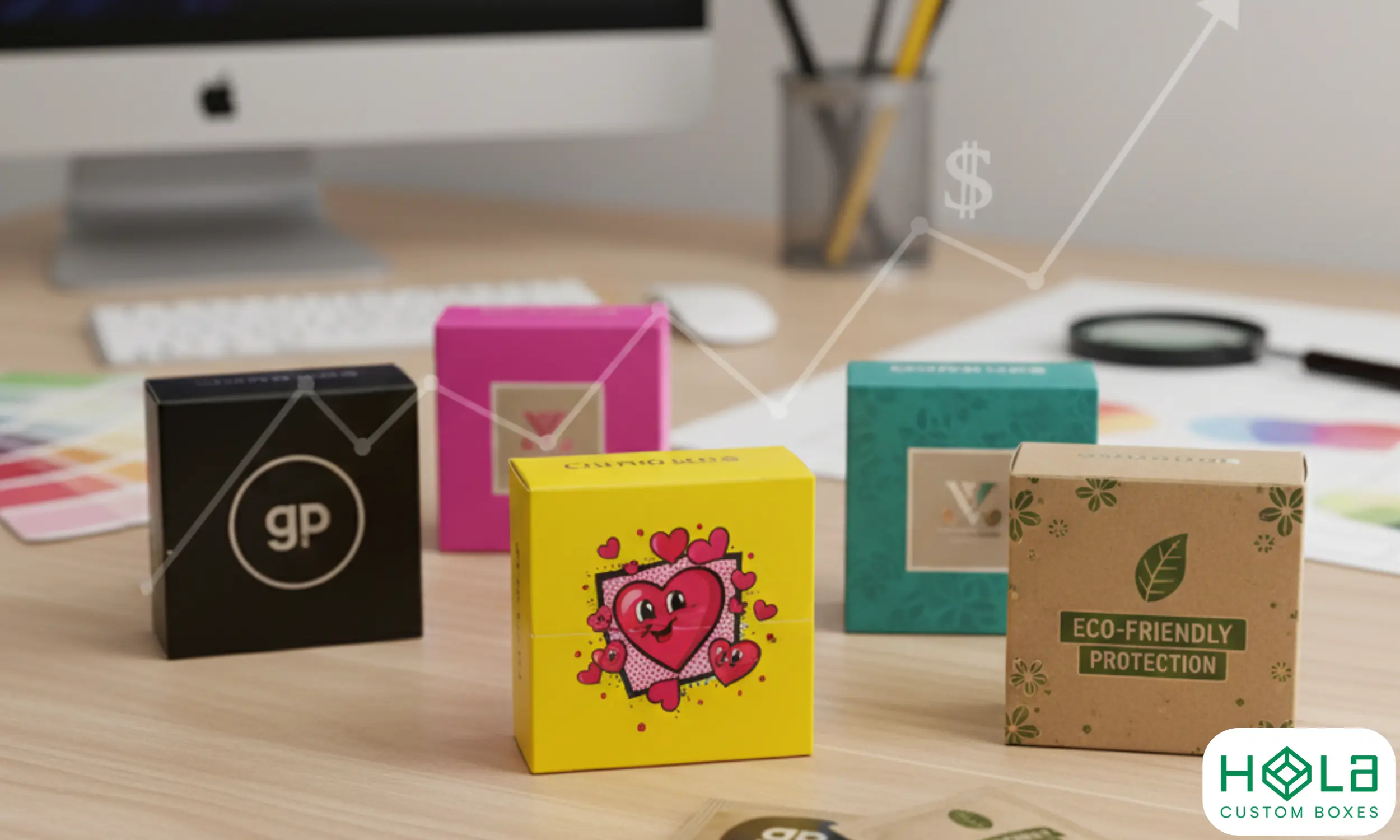
Custom Discreet Condom Boxes With Tamper-Evident Packaging

Discreet and Compliant Condom Boxes by Hola Custom Boxes
With Hola Custom Boxes, you can specify discreet condom boxes that use plain, non-descriptive panels, neutral matte colorways, and only the regulatory labeling required for compliance. You’ll still include product identity, material type, quantity, lot or batch code, expiry date, storage statements, allergy cautions, and manufacturer details for traceability. To prevent rattling, cartons can be sized tightly with pocketed inserts or trays, then validated through shake testing. Keep going to see closure, material, and finish options.
Brands that need privacy-focused packaging with strong regulatory discipline often choose custom condom boxes engineered to balance discreet presentation, traceability, shipping protection, and packaging consistency across retail and fulfillment channels.
Main Points
Hola Custom Boxes offers plain, non-descriptive condom boxes with neutral matte finishes, tamper-evident closures, and minimal external markings for discretion.
Boxes include required compliance details: product identity, material, quantity, lot or batch number, expiry date, manufacturer information, and regulatory marks.
Clear safety warnings are integrated, including storage instructions, handling guidance, allergy cautions, and single-use statements, without unnecessary sexual-health graphics.
Cartons are sized for a tight fit and stable packout, using pocketed inserts, blister cavities, or dividers validated through shake testing to prevent movement.
Shipping-ready materials can use SBS or FBB paperboard, higher caliper strength, protective coatings, moisture barriers, and anti-counterfeiting details such as microtext with durable scuff benchmarks.
What Makes a Condom Box Truly Discreet?
While “discreet” is often used loosely as a marketing term, a truly discreet condom box is defined by controlled packaging decisions that can be verified in production. It uses plain, non-descriptive exterior panels, avoids product names or unnecessary sexual-health graphics on visible faces, and limits external labeling to what regulations actually require.
It also relies on secure, tamper-evident closures and opaque materials so the contents cannot be inferred through handling, light exposure, storage, or shipping.
Discretion is reinforced further by standardizing neutral colorways, matte finishes, and low-profile seams that do not call attention to the product category.
Opaque board or films can be specified with tested light-blocking performance, while attention-grabbing scent coatings should be avoided. Shipping risk can also be reduced through plain outer mailers, concealed return labeling where permitted, and consistent carton sizing so exterior dimensional clues do not reveal the contents.
With Hola Custom Boxes, this level of discretion can be planned at the structural and print-spec level rather than left to appearance alone.
What Labels and Warnings Must Condom Boxes Include?
Because condom packaging falls into a regulated consumer-safety and medical-related category in many markets, labeling cannot be treated as optional or purely aesthetic. The box must carry the exact warnings, identifiers, and traceability information required by the target jurisdiction.
This typically includes product identity, such as condoms, material type, lubricated or non-lubricated designation, quantity, and size or nominal width where required.
Lot or batch number, a manufacturing-site identifier where applicable, and an expiry date tied to stability data must also be included.
Storage and handling statements such as keeping the product in a cool, dry place away from sunlight are commonly required, along with single-use warnings. Latex or natural rubber content, spermicidal ingredients, and allergy cautions should also be disclosed where relevant.
Instructions for use, or a reference to enclosed instructions, may also need to appear alongside a warning to read those instructions before use. The manufacturer or importer name, address, country of origin, regulatory marks, and barcode or UDI details may also be mandatory, depending on market requirements.
All claims printed on the packaging should remain substantiated and legally supportable.
What Condom Box Sizes and Inserts Prevent Rattling?
Once warnings, identifiers, and traceability marks are set, the packout still has to keep each unit stable in transit and on shelf.
The carton should be sized according to the primary pack, with a target clearance in the range of roughly 0–1.5 mm on length and width and 0–1.0 mm on depth so the contents do not shift while still avoiding crush.
For foil pillow packs, a snug pocketed insert matched to the pouch footprint can keep seals from rubbing. For blistered units, a cavity insert that captures the blister flange can help prevent edge chafe.
If multiple units are bundled in one carton, dividers or multi-cell trays should be used to prevent individual packs from colliding during handling.
Validation should include shake testing. A properly fitted box should produce no audible rattle, no seal abrasion, and no corner damage after standard handling simulation. Final tolerances and inspection criteria should then be documented clearly for repeat production.
This is where Hola Custom Boxes can help convert exact product dimensions into a repeatable discreet packout that feels controlled rather than loose or improvised.
Which Materials Protect Condom Boxes in Shipping?

After the fit and inserts have been engineered to eliminate movement, the board and barrier materials still need to withstand compression, vibration, humidity, and handling without scuffing the compliance text or compromising lot and expiry legibility.
SBS or FBB paperboard is often specified for applications requiring clean print fidelity and smoother surfaces. CCNB can be used when additional cost control is required, but only after ink adhesion and rub resistance are validated.
Choose SBS or FBB for crisp print performance; use CCNB only with proven ink rub resistance, then confirm caliper through shipper-specific compression testing.
Caliper should be increased as needed to ensure stacking strength, then validated through compression tests aligned with the actual shipper configuration. Aqueous or UV coatings can be added to reduce abrasion while keeping barcodes readable. For moisture exposure, PE or water-based dispersion barriers may be appropriate, along with adhesive systems rated for the expected transit conditions.
Odor-neutral, low-migration materials should be required to ensure the packaging does not introduce off-odors or unwanted transfer. Material specifications, supplier certificates, and testing benchmarks should also be documented as part of the packaging standard.
Do You Need Tamper-Evident Condom Box Closures?
If the goal is to show that a condom box has not been opened, altered, or reclosed before reaching the end user, standard tuck flaps alone are often not enough.
Tamper-evident closures provide visible, irreversible evidence of tampering and strengthen the product's quality control system. Pressure-sensitive seals, perforated tear strips, shrink bands, or locking tabs that fiber-tear on opening can all serve this purpose, depending on the carton format.
The specification should define exactly where the seal must break and what constitutes an unacceptable condition, such as missing seals, re-adhered labels, or poor seal placement. These closures should then be validated under shipping and storage conditions and included in receiving and final packout inspection procedures.
Where multiple handlers or fulfillment steps are involved, tamper evidence becomes a practical risk-mitigation measure rather than a cosmetic add-on.
How Do You Print Discreet Condom Boxes Without Looking Generic?
Tamper-evident closures help protect integrity, but the exterior still needs to protect customer privacy without appearing suspiciously generic. Discreet printing works best when neutral branding, controlled color palettes, and a clear labeling hierarchy are all handled deliberately.
Required information should remain readable, while nonessential visual cues stay subdued. Variable data or compact batch coding can support traceability without advertising the contents. Imagery should remain abstract; explicit product photography should be avoided; and secondary descriptors can be placed on interior panels where regulations allow.
Print standards such as Pantone targets, opacity, and barcode grading should be defined early to ensure consistent, auditable output.
| Risk | What you print | Your control |
|---|---|---|
| Overexposure | Explicit terms on front | Move to side panel |
| Noncompliance | Missing warnings | Fixed label template |
| Counterfeit | Generic layout | Microtext + lot code |
| Returns | Confusing brand | Subtle logo + URL |
This lets Hola Custom Boxes create packaging that feels private and intentional without sacrificing regulatory clarity.
Which Finishes Keep Condom Packaging Subtle and Scuff-Resistant?
Discreet branding often fails first at the high-touch edges and panels that scuff, polish, or reflect too much light. That is why finishing selection matters as much as the artwork itself.
Matte aqueous or matte UV coatings can help create low-reflective surfaces that maintain a discreet appearance. Rub-resistance and coefficient-of-friction targets should be specified to prevent cartons from becoming glossy due to repeated handling during packing or transit.
For darker solids, anti-scuff overprint varnishes can help preserve appearance. Any finish chosen should also remain compatible with tapes and labels to prevent lifting.
If a softer, more premium texture is needed, soft-touch lamination can be used, but it should be specified with fingerprint- and oil-resistance, as vague finish specs can lead to visible wear. High-gloss flood UV should generally be avoided near compliance text and lot coding, as glare can reduce readability.
Transport testing and scuff benchmarks should be required before final approval.
Frequently Asked Questions
What Is the Typical Turnaround Time for Custom Discreet Condom Boxes?
Custom discreet condom boxes are often produced in about 10–20 business days after artwork approval and payment, though rush production can sometimes shorten that to around 5–10 business days.
Shipping time is additional and may add several days depending on the destination and method. Compliance review, barcode verification, tamper features, and proof approvals can also extend timelines if not finalized early.
Submitting print-ready artwork, confirming the dieline in advance, and requesting a pre-production proof can reduce delays.
Can I Order Small Quantities, and What Are the Minimum Order Requirements?
Yes, smaller quantities can often be ordered, but the exact minimum order quantity depends on the box style, material, print process, and compliance requirements.
MOQ should be confirmed in writing per SKU and clarified as either per design, per size, or per total production run. Labeling setup, lot coding, and barcode requirements may also affect the minimum quantity or create setup charges.
Do You Offer Design Assistance for Branding While Keeping Packaging Discreet?
Yes. Design assistance can support brand identity while still keeping the packaging discreet.
This typically includes collaboration on minimal exterior cues, neutral color systems, compliant label placement, and artwork hierarchy. Dielines, proofs, and print specifications can be reviewed to reduce accidental overexposure of the product category.
Plain shipper cartons and non-descriptive return information can also be coordinated where permitted, while all symbols, notices, and claims are checked against target-market requirements before production.
How Are Custom Condom Boxes Priced, Including Plates, Shipping, and Setup Fees?
Pricing is usually based on carton size, material selection, structure, print method, coverage, finishing, and total quantity.
One-time setup charges and, where applicable, plate or die charges may apply. Digital printing may reduce or eliminate some plate costs. Shipping is then calculated based on carton count, total weight, destination, and delivery speed, with customs or tax implications depending on the shipping terms.
The safest approach is to request a written quote that itemizes each fee and any tolerance or specification assumptions.
Can You Ship Boxes to Multiple Fulfillment Locations or Third-Party Logistics Providers?
Yes, boxes can typically be shipped to multiple fulfillment locations or 3PLs.
To do this properly, each address, contact, dock requirement, and delivery window should be confirmed in advance. Separate purchase orders or line-item splits may help prevent inventory allocation errors across destinations.
Each fulfillment point should also meet the required storage, labeling, and handling conditions. Tracking records, bills of lading, and delivery confirmations are useful for maintaining an audit trail.
Final Thoughts
When sourcing discreet condom boxes, the challenge is not just appearance—it is balancing privacy with compliance at every stage of the packaging system. Required labels, warnings, lot and expiry details, and traceability marks still need to remain accurate and readable even when the design is intentionally minimal.
With Hola Custom Boxes, brands can size cartons precisely, add fitted inserts to reduce movement, and choose materials that withstand shipping without compromising regulatory text or batch legibility. Where needed, tamper-evident closures can strengthen chain-of-custody, and subtle print treatments can maintain privacy without stripping away the required information.
By combining discreet structural design, traceable labeling, shipping-safe materials, and scuff-resistant finishes, Hola Custom Boxes helps create packaging that protects both the product and the customer experience.