
Multi-Caliber Packaging Solutions: Universal, Adjustable & Custom Divider Systems
2026-01-14 11:52:55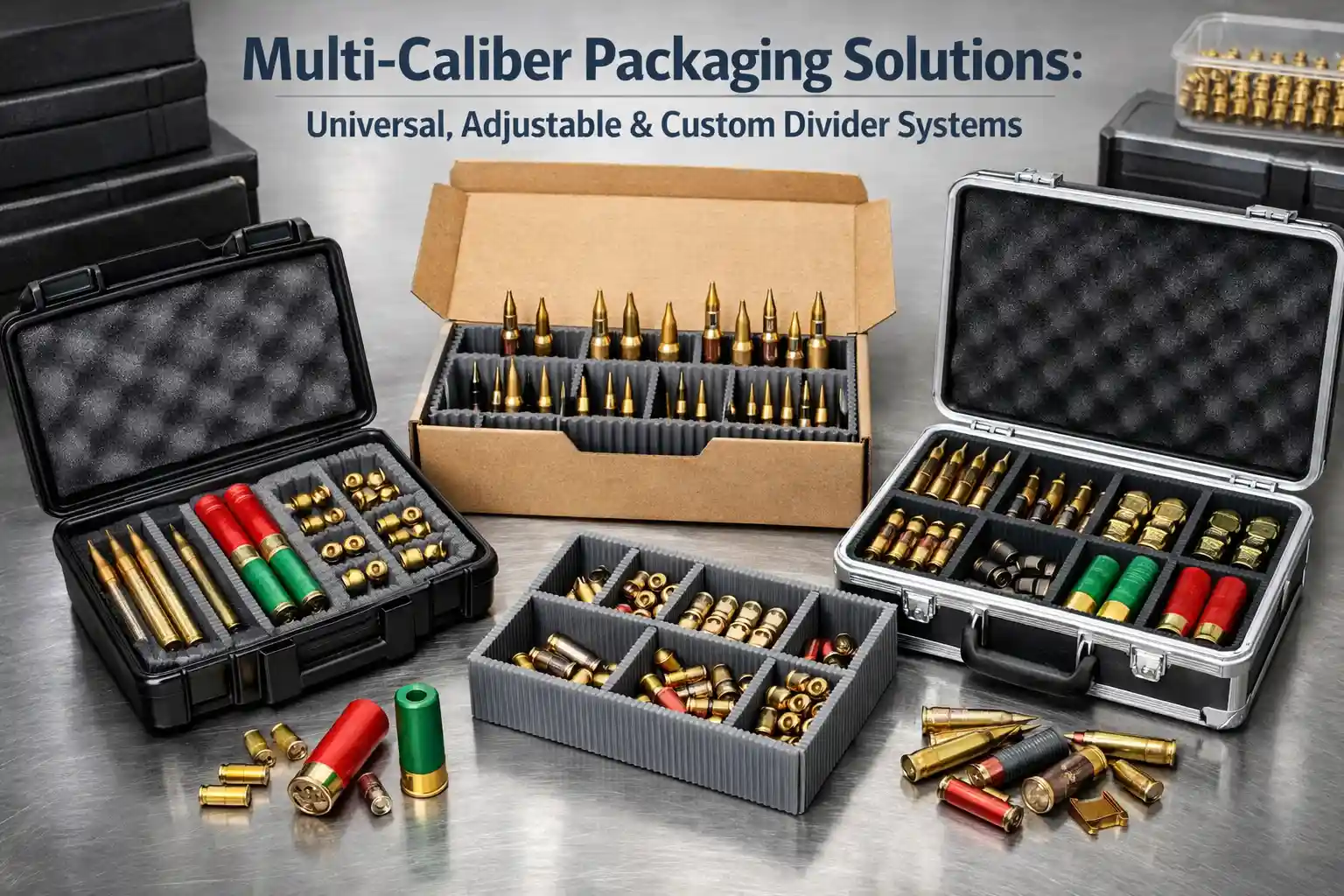
Multi-Caliber Packaging Solutions: Universal, Adjustable & Custom Divider Systems
When you’re shipping multiple calibers or cartridge sizes, you can’t afford wasted space, rattling parts, or a warehouse full of cartons. Multi-caliber packaging helps you standardize protection across shifting SKUs, but the divider system you choose changes everything. Universal grids simplify inventory, adjustable dividers speed changeovers, and custom inserts lock down fragile components. The real question is what you’re optimizing—fit range, throughput, or damage risk—and where the tradeoffs start showing up.
Main Points
- Multi-caliber packaging uses tolerance ranges and adjustable retention to fit multiple calibers while preventing rattling, damage, and dead inventory.
- Universal divider grids standardize cell patterns across SKUs, reducing carton variety, purchasing complexity, and pack-out errors.
- Adjustable divider systems reconfigure cell sizes quickly, maintaining line uptime and snug fits as SKU mixes and demand shift.
- Custom divider systems match exact part geometry, maximizing protection with options like foam, molded pulp, liners, and reinforced rails.
- Choose universal, adjustable, or custom dividers based on size variation, volume stability, budget, and lead time to balance flexibility and cost.
What Is Multi-Caliber Packaging (and Why It Matters)?
Whether you’re shipping ammo for a single SKU or juggling a mixed lineup, multi-caliber packaging means one package design can securely fit and protect more than one caliber or cartridge size.
You achieve this by building in tolerance ranges, adjustable retention, or adaptable cavities so rounds don’t rattle, tip, or crush under load. It matters because it cuts tooling changes, reduces carton variations, and simplifies purchasing, kitting, and warehouse slotting.
You’ll also speed up pack-out when demand shifts between calibers, since you don’t wait on dedicated inserts. With fewer package types, you lower dead inventory and reduce changeover errors.
Done right, you still meet protection goals and presentation needs while keeping costs predictable across production runs.
Universal Divider Systems: Best for Mixed SKUs

A smart grid can turn one box into a reliable home for a mixed lineup of calibers. With universal divider systems, you pack multiple SKUs using a consistent cell pattern that supports common diameters and lengths without special tooling.
You reduce carton variety, simplify purchasing, and keep packouts predictable across shifts and sites.
You’ll also cut picking errors because the layout stays familiar: operators drop each unit into a defined cell, and quality checks become faster.
Universal grids protect finishes by preventing contact, limit rattling in transit, and present products neatly for counting and scanning. They’re especially useful when your order mix changes daily, you ship sampler packs, or you build assortment kits.
Universal grids prevent contact, reduce rattling, and keep items neat for counting and scanning—ideal for fast-changing mixes and assortment kits.
When you need dependable protection for many SKUs in one standard box, universal dividers deliver.
Adjustable Divider Systems: Fastest Changeovers, Better Fit
When your SKU mix shifts or a new caliber shows up mid-run, adjustable divider systems let you reconfigure cell width and depth in minutes instead of swapping to a different insert. You slide, lock, and go—keeping line uptime high while still dialing in a snug, repeatable fit across multiple calibers.
Instead of “making it work” with empty space, you tune each lane so parts don’t rattle, tip, or migrate during handling and transport. That means fewer rework loops and more consistent counts at packout.
- You loosen a tab and hear the click as the grid re-indexes
- You nudge dividers inward until each round seats cleanly
- You flip a stop to shorten cells for stubby lengths
- You label settings so the next changeover’s instant
Custom Divider Systems: Maximum Protection for Fragile Parts
Fragile parts demand a divider system that fits like a glove, not a compromise. With custom dividers, you design every cell around your part’s exact geometry, contact points, and handling risks. You eliminate rattle, edge impact, and part-to-part collision by controlling clearances and adding localized cushioning where it matters most.
You can tune materials and construction for your environment: corrugated, foam, molded pulp, or hybrid builds. You can integrate features like finger cutouts for safe retrieval, reinforced rails for stacking strength, anti-abrasion liners, and orientation keys that prevent misloads.
If your parts have finishes, optics, or tight tolerances, custom partitions keep surfaces isolated and clean through repeated moves. The result is fewer rejects, less rework, and more predictable quality at unpacking.
Choosing a Divider System: Fit Range, Volume, Budget, Lead Time

Even if your parts share a “family” shape, the right divider system depends on how wide your fit range runs, how many units you’ll ship, what you can spend per pack, and how fast you need it in production.
If sizes swing widely, choose adjustable dividers or modular inserts so one pack covers multiple SKUs. If volume is high and stable, a custom grid often wins on unit cost and throughput.
When budgets are tight, start with universal cells and upgrade later. When lead time is the constraint, pick stock components and simple tooling, then iterate once data proves the packout.
Picture your decision like this:
- A ruler spanning your smallest to largest part
- A conveyor feeding thousands of identical trays
- A calculator trimming pennies per shipset
- A clock counting weeks to launch
Frequently Asked Questions
Can Multi-Caliber Divider Systems Meet UN or DOT Hazardous Shipping Requirements?
Yes, you can meet UN or DOT hazardous shipping requirements with multi-caliber divider systems, but you must validate them. You’ll use tested materials, follow packing instructions, verify inner containment, and document performance testing.
How Do Dividers Perform Under Vibration, Drop, and Compression Testing Standards?
You’ll see dividers perform well when you spec material grade, fit, and retention: they limit movement under vibration, prevent breakage in drops, and maintain spacing in compression—if you validate with ISTA/ASTM tests.
Are Divider Materials Compliant With FDA, Rohs, or REACH Regulations?
Yes—you can source divider materials compliant with FDA, RoHS, and REACH, but you’ll need documented certifications. Ask suppliers for declarations, test reports, and traceability. You should also confirm additives, inks, and adhesives meet limits.
What Cleaning and Reuse Protocols Apply for Returnable Multi-Caliber Packaging?
You’ll set cleaning and reuse protocols based on risk: wash, rinse, and sanitize between cycles; dry completely; inspect for damage; track usage with logs; segregate contaminated returns; and follow customer, industry, and regulatory requirements.
Can Dividers Be Tracked With RFID, QR Codes, or Asset Management Systems?
Yes—you can track dividers using RFID tags, QR codes, or asset-management platforms. You’ll assign unique IDs, scan at pack/ship/return points, and sync locations and condition. You can automate alerts for loss, damage, and maintenance.
Final Thoughts
You simplify logistics when you switch to multi-caliber packaging. You’ll ship more SKUs with fewer cartons using universal dividers, adapt quickly with adjustable systems, and protect delicate parts with custom designs that stop rattle and impact. As your mix changes, you won’t get stuck with excess inventory or costly changeover mistakes. Choose the divider approach that matches your fit range, volume, budget, and lead time—and you’ll keep operations efficient and products intact.