
Custom Candle Packaging for Small Businesses in USA by Hola Custom Boxes
2026-01-25 11:42:22
Custom Candle Packaging for Small Businesses in USA by Hola Custom Boxes
You’ll get USA-made custom candle packaging from Hola Custom Boxes that fits your jars precisely and keeps unit costs predictable, even at low MOQs. Measure jar diameter and height in millimeters across three samples, then add 2–3 mm for width/depth and 3–5 mm for height. Choose efficient box styles for DTC or retail, and spec 18–24 pt SBS or E-flute for heavier glass. Add die-cut inserts or dividers to stop breakage. Keep going to see spec and finish options.
Main Points
- Hola Custom Boxes offers custom candle boxes for U.S. small businesses, with low MOQs and scalable options for growing product lines.
- Measure jars in millimeters, including lid overhang and taper; add 2–3 mm clearance and 3–5 mm height for easy closure.
- Choose box styles that match DTC shipping, retail shelves, or gift sets, balancing protection, branding visibility, and assembly cost.
- Use 18–24 pt SBS for retail graphics, or E-flute corrugated for heavier glass; add aqueous coating to reduce scuffs in transit.
- Add die-cut inserts or dividers to prevent jar movement and glass contact, cutting breakage rates and improving the unboxing experience.
Measure Your Jars for Custom Candle Boxes
Before you order custom candle boxes, take three core measurements of every jar SKU—diameter, overall height (including lid), and base profile—using a caliper or rigid ruler for repeatable accuracy.
> Before ordering custom candle boxes, measure each jar SKU’s diameter, overall height (with lid), and base profile using calipers or a rigid ruler.
Record in millimeters to reduce rounding errors, and measure three samples per SKU to capture manufacturing tolerance. Specify clearance: add 2–3 mm to width and depth for easy insertion, plus 3–5 mm to height for friction-free closure and label protection.
Note lid overhangs, seams, and any tapered glass; these drive internal fit more than nominal volume. If you use inserts, measure the jar’s widest point and the base contact area so the insert won’t rock.
Build a simple spec sheet and share it with Hola Custom Boxes to prevent reprints, reduce freight void-fill, and keep your branding aligned across sizes.
Choose the Right Candle Box Style
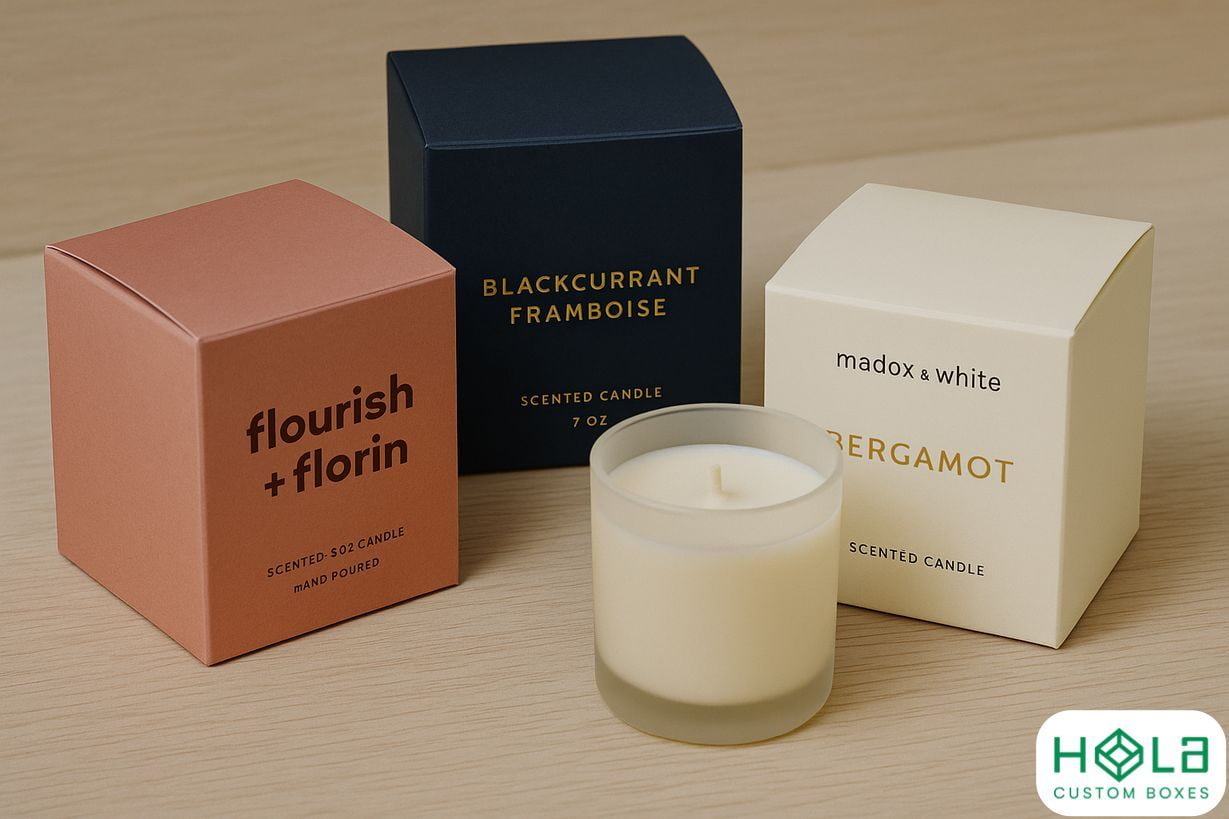
Once you’ve locked in jar dimensions and clearance, pick a candle box style that protects the glass, showcases your branding, and keeps unit cost predictable at your order volumes.
Your choice should match how you sell: DTC, retail shelf, or gift-ready bundles. Prioritize styles that run efficiently on standard dies so you don’t pay unnecessary tooling or hand-assembly time.
Select closures that keep panels square for consistent label registration and barcode placement, and choose a layout that supports inserts without complicated packing steps. For premium lines, consider unboxing feel without overbuilding the structure.
Use these checkpoints:
- Tuck-end: fastest to pack, scalable, clean front panel for branding.
- Auto-lock bottom: higher speed setup, better load control for heavier jars.
- Two-piece rigid: luxury presentation, best for sets, higher per-unit cost.
Pick Materials That Survive Candle Shipping
After you’ve chosen a box style, the material spec does the real work of getting your candle to the customer intact while keeping print quality and unit cost in check.
For most small-batch brands, 18–24 pt SBS gives crisp graphics and clean folds for retail-ready unboxing. For heavier glass jars, step up to E-flute corrugated (32 ECT) or 200# test to handle drops and compression in parcel networks without overbuilding.
Specify aqueous coating for scuff resistance and faster packout; go matte for premium branding or gloss for color pop. Use kraft linerboard when you want a natural look and better hide transit abrasions.
Keep caliper consistent to avoid lid fit issues and rework. Validate with basic drop and crush testing pre-launch.
Add Inserts and Dividers to Stop Breakage
Two things stop most candle breakage in transit: immobilization and cushioning, and you get both by spec’ing the right insert or divider.
Use inserts to lock the jar’s diameter, cap height, and base so it can’t rattle, then add controlled crush space to absorb drops. You’ll cut damage claims, reduce overboxing, and keep shipping weights predictable—key for small-batch margins with Hola Custom Boxes.
- Choose structure: die-cut SBS or corrugated inserts for rigidity; molded pulp for shock absorption; foam only when weight or fragility demands it.
- Match tolerances: size cavities within ~1–2 mm of jar OD; add lift tabs for fast packing and fewer fingerprints.
- Use dividers smartly: grid dividers prevent glass-to-glass contact and let you ship multiples without extra void fill.
Print and Design Candle Packaging That Sells
Three design decisions—color, typography, and finish—do most of the selling on candle packaging, so treat your box like a mini billboard that has to convert in under a second.
Start with a tight brand palette (1–2 spot colors) so you control ink costs and keep SKU consistency across scents. Use high-contrast type, limit fonts to two, and size key claims for a 3-foot shelf read: scent name, burn hours, wax type, and net weight.
Build hierarchy with grids and safe margins to avoid trimming errors. Add a UPC and batch field for retail and QC.
Choose print methods based on volume: digital for short runs, offset for scale. Proof in CMYK and run a press check.
Use Finishes to Make Candle Boxes Look Premium
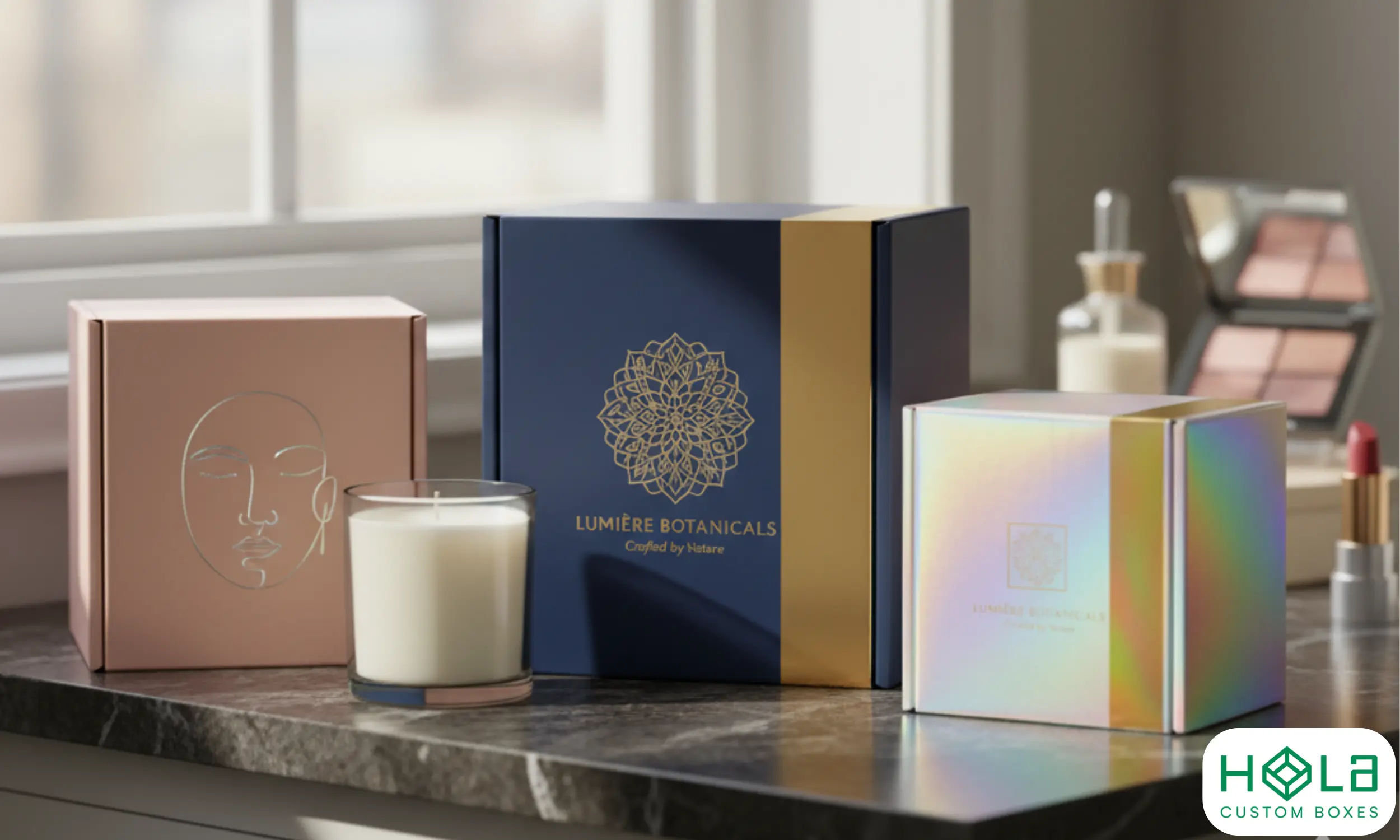
Your print choices set the foundation, but finishes are what make a candle box feel expensive in-hand and stand out under retail lighting.
Print is the base—finishes create that expensive in-hand feel and help your candle box pop under retail lighting.
You’ll control gloss, texture, and contrast to guide attention to your brand mark while protecting ink from scuffs. Choose finishes that match your scent profile: soft-touch reads calm and luxe, while high-gloss signals vibrant and modern.
- Matte or soft-touch lamination: boosts perceived value and adds rub resistance, reducing reprints.
- Spot UV or raised UV: isolates your logo or key claims for high-impact hierarchy without extra colors.
- Foil stamping or emboss/deboss: delivers crisp metallic cues and tactile branding; keep coverage tight to manage die and setup costs.
Pair one hero finish with a durable coating for a premium, cost-smart result.
Order Low-MOQ, USA-Made Custom Candle Packaging
Speed matters when you’re restocking candles on a tight launch calendar.
With Hola Custom Boxes, you can order low-MOQ, USA-made custom candle packaging that keeps lead times short and inventory lean. You’ll validate box size, insert fit, and label alignment without committing to thousands of units.
Domestic production cuts transit risk, supports faster reorders, and stabilizes unit cost by reducing freight and customs surprises.
You can spec SBS, kraft, or rigid setups, dial in caliper for crush strength, and match dielines to your jar footprint for tight tolerances.
If you’re running seasonal scents, low quantities let you version graphics, update compliance copy, and A/B test finishes while protecting cash flow.
You’ll scale smoothly once sell-through data proves demand.
Frequently Asked Questions
Do Custom Candle Boxes Need FDA or CPSIA Compliance in the USA?
Custom candle boxes don’t usually need FDA compliance, and CPSIA applies only if you market the candle or packaging as a children’s product (≤12) or include regulated components.
You must still meet general safety and labeling expectations: avoid misleading claims, guarantee inks/coatings are non-toxic for intended use, and follow state rules (like California Prop 65 warnings).
You’ll save costs by specifying compliant materials only where required.
Can You Include Legally Required Candle Warning Labels on the Packaging?
Yes—you can include legally required candle warning labels directly on your packaging.
You’ll print the ASTM F2058 fire-safety warning (or use a compliant label) and add any state-required language, plus net contents and business ID where applicable.
You’ll control placement on primary panels for visibility, then verify font size, contrast, and permanence.
You’ll reduce unit cost by integrating warnings into artwork instead of applying separate stickers.
Are Child-Resistant Candle Boxes Available for Certain Wax Melts or Candles?
Yes—you can specify child-resistant candle boxes for select wax melts or candles; it’s like adding a lock to your brand’s front door.
You’ll choose CR features such as push-and-turn closures, tear-resistant lidding, or certified CR cartons where applicable.
You should match the format to product size, melt count, and retail channel.
You’ll also control costs by using standard dielines, minimal inserts, and scalable MOQ options.
What Are Typical Turnaround Times During Peak Holiday Candle Seasons?
During peak holiday candle seasons, you’ll typically see 10–20 business days for standard custom candle boxes, and 5–10 days for rush production, plus 2–7 days shipping.
If you add foiling, embossing, specialty inserts, or child-resistant features, expect 3–7 extra days.
You’ll protect costs by locking dielines early, approving digital proofs within 24 hours, and ordering 6–8 weeks ahead.
Do You Offer Sustainable Inks and Adhesives for Eco-Friendly Candle Packaging?
Yes—you can choose sustainable inks and adhesives for eco-friendly candle packaging.
You’ll get soy/vegetable-based or water-based inks with low-VOC profiles, plus FSC-friendly paper stocks.
You can also spec water-based, starch, or dextrin adhesives and avoid solvent laminations.
You’ll keep costs controlled by selecting standard ink sets, minimizing coverage, and using recyclable coatings.
You can request compliance documentation and run samples before full production.
Final Thoughts
You’ve tested the theory that packaging is just a container, and it doesn’t hold up. When you measure jars, choose a shipping-safe style, spec durable board, and add inserts, you don’t just reduce breakage—you cut replacement costs. When you print with disciplined branding and premium finishes, you don’t just decorate—you increase perceived value. Order low-MOQ, USA-made runs from Hola Custom Boxes, and you’ll validate the deeper truth: smart packaging drives margin.