Candle Packaging Company USA: How Hola Custom Boxes Supports Growing Candle Brands
2026-01-27 12:27:57
Candle Packaging Company USA: How Hola Custom Boxes Supports Growing Candle Brands
When you choose a USA candle packaging company, you’re chasing measurable gains: lower defect rates, consistent lead times, and fewer breakage returns. With Hola Custom Boxes, you can match packaging to jars, tins, or melts using snug inserts, scuff-resistant mailers, and compartmented trays that cut void fill and DIM weight. You’ll validate color accuracy, emboss depth, and barcode scannability with real samples, and you can spec FSC paper, recyclable coatings, and low-VOC inks. Keep going to see options, timelines, and pricing tiers.
Main Points
- Hola Custom Boxes supports U.S. candle brands with consistent lead times, reorder reliability, and QC documentation to reduce defects and late shipments.
- They tailor packaging to candle formats—jars, tins, and melts—using inserts and durable corrugate to minimize breakage and scuffing.
- They offer scalable MOQs and transparent pricing tiers, helping brands grow without sudden margin shocks.
- They offer sustainable materials such as FSC-certified paper, recyclable coatings, and low-VOC inks for eco-forward branding.
- They validate premium print and finish quality with samples, ensuring color accuracy, emboss depth, and barcode/QR scannability for smooth fulfillment.
How to Choose a USA Candle Packaging Company
Where do you start when dozens of vendors claim they’re the “best” in candle packaging?
You start by benchmarking measurable outcomes: defect rate, lead-time consistency, and reorder reliability. Ask for recent on-time shipment percentages and documented QC checks, not promises.
Next, prioritize trend-aligned materials: FSC-certified paper, recyclable coatings, and low-VOC inks, since sustainability claims increasingly influence conversion and retailer acceptance.
Then, validate print capability with real samples—color accuracy, emboss depth, and barcode scannability—because shelf impact is a revenue lever.
You’ll also want transparent MOQs and pricing tiers so you can scale without margin shocks.
Finally, choose a partner with U.S.-based support and fast proof cycles to cut launch delays and reduce revision costs, especially during seasonal peaks.
Match Packaging to Your Candle Type (Jars, Tins, Melts)
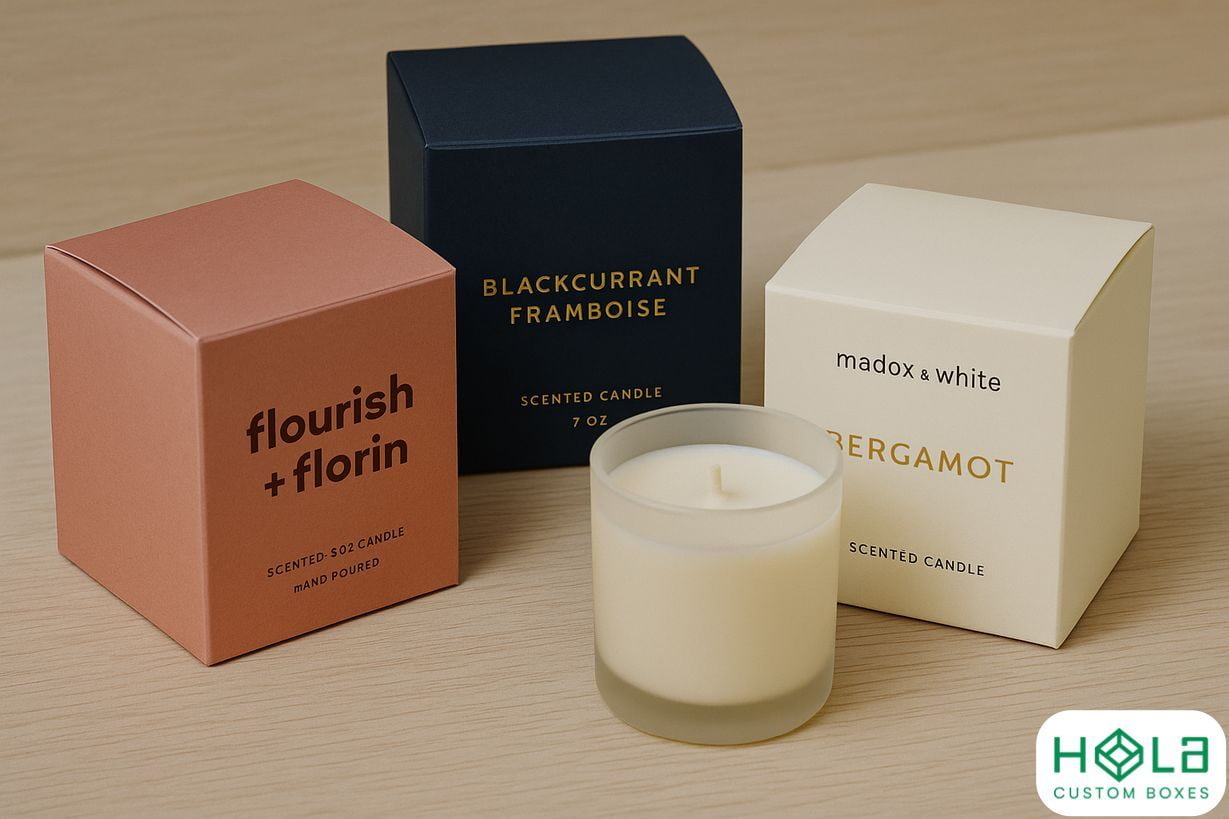
Three candle formats—jars, tins, and melts—require different packaging specs to achieve fewer damages, faster packing, and better shelf conversion.
Start with jars: you’ll cut breakage by using rigid walls, snug inserts, and drop-tested corrugate sized to your glass and lid height.
For tins, focus on scuff resistance and dent control; choose tighter tolerances, crush-strong mailers, and anti-rub coatings to keep labels retail-ready.
For melts, you’ll win on speed and freshness: use compartmented trays or sleeves that prevent shifting, then add barrier films that reduce fragrance loss during longer transit.
Trendwise, brands that standardize box footprints across sizes lower dimensional-weight fees and improve pick-pack throughput.
Match protection to fragility, and you’ll keep returns down while boosting unboxing impact.
Custom Candle Packaging Options From Hola Custom Boxes
Because packaging now doubles as a conversion lever and a damage-control tool, Hola Custom Boxes lets you tailor candle packaging around measurable outcomes—lower breakage rates, faster pick-pack time, and stronger shelf impact.
Packaging is both a conversion lever and damage-control tool—tailor candle boxes for less breakage, faster pick-pack, and stronger shelf impact.
You choose structures and inserts that align with your SKU mix, order profiles, and channel needs (DTC, retail, wholesale). To keep performance trackable, you can configure:
- Sized-to-product box dimensions to cut void fill and reduce DIM weight charges.
- Insert and divider layouts to stabilize jars/tins, limit scuffing, and pass common drop-test targets.
- Packaging styles (mailer, tuck-end, two-piece, display-ready) to match unboxing UX and planogram requirements.
You can also add barcode/QR placement zones and clear labeling panels to speed scanning and reduce mis-picks.
Premium Materials and Finishes (Paper, Foil, Embossing)
While substrates and finishes might seem like pure aesthetics, they directly influence shelf conversion, perceived value, and transit performance—so you’ll want to spec paper stock, foil, and embossing with intent.
Start with paper: SBS delivers crisp print and clean whites for modern minimal labels, while kraft signals “natural” and boosts eco cues; heavier calipers also reduce panel warping.
For premium lines, choose soft-touch or matte aqueous coatings to reduce glare and enhance “hand-feel.”
Use foil sparingly: cold foil scales well for runs, hot foil delivers a sharper metallic pop for giftable SKUs, and both can boost on-shelf stop power.
Embossing/debossing adds tactile branding and makes logos readable at arm’s length—ideal for dark palettes and low-ink designs.
Shipping-Safe Features for Fragile Candles (Inserts, Drop Tests)
Premium finishes can win the shelf, but your candle packaging has to survive the carrier network first—where most damage comes from drop impacts, side compression, and vibration.
You reduce breakage by engineering packaging around measurable risks, not guesswork. Hola Custom Boxes helps you specify protective systems that match jar weight, wax brittleness, and transit zones, then validates them with repeatable testing.
- Precision inserts: Use molded pulp, EVA, or corrugated partitions to lock the vessel, protect the rim, and maintain clearance so glass never contacts outer walls.
- Compression-resistant structures: Choose double-wall corrugate and reinforced corners to withstand stacking loads and carrier sortation.
- Drop-test validation: Run ISTA-style drops at multiple orientations and heights, then iterate dielines based on failure points and pass rates.
Packaging Branding Details That Boost Repeat Buyers
Even if your candle wins on scent, repeat buyers often come from the brand cues they see and feel in the first 10 seconds of unboxing—so your packaging needs intentional, trackable details.
Use a consistent color system and typography hierarchy so customers recognize you in a scroll; brands that standardize visual codes reduce decision friction and lift reorders.
Add a short “scent story” panel plus burn-time and wax-type icons to speed comprehension and cut returns.
Make the opening moment tactile: soft-touch coating, embossed logo, or a matte label with spot UV drives perceived value without extra copy.
Include a QR that lands on a reorder page with UTM tags, then A/B test placements.
Finish with a reusable vessel-care insert to keep you top of mind.
MOQ, Pricing, and Ordering Timeline With a US Supplier
If you’re sourcing candle packaging from a US supplier, you’ll usually see MOQs in the 250–1,000 unit range per SKU (with simpler folding cartons trending lower and custom rigid boxes trending higher), and your unit price drops 10–30% as you scale past key breakpoints like 1k and 5k.
To control landed cost, you’ll want to standardize dielines, limit spot colors, and reserve premium finishes for hero SKUs.
Typical US timelines run 7–12 business days after proof approval, with rush options when capacity allows.
You can de-risk launches by sequencing buys:
- Prototype: 1–3 days for dieline + digital proof.
- Production: 7–12 days printing, die-cut, QC.
- Shipping: 1–5 days domestic transit, tracking included.
Frequently Asked Questions
Do You Offer Eco-Friendly Candle Packaging Certifications, Such as FSC or SFI?
Yes—you can request eco-friendly candle packaging using FSC-certified paper and, where available, SFI-certified stock through our material network.
You’ll receive chain-of-custody documentation tied to your specific paper grade and print run, helping you substantiate sustainability claims.
You can also choose recycled content, soy/vegetable inks, and water-based coatings to align with retailer requirements and rising consumer preference for low-impact packaging.
Share specs, and you’ll get options.
Can You Print Scannable QR Codes or Barcodes on Candle Boxes?
Yes—you can print scannable QR codes and barcodes on your candle boxes.
Like a digital handshake, they connect shoppers to product pages, safety info, and reorder flows.
You’ll get high-resolution printing, proper contrast, and quiet zones to improve scan rates.
You can test with GS1/UPC or custom QR formats, then A/B placement on panels.
If you want, you can pair them with FSC/SFI-certified stocks too.
Are Your Candle Packaging Designs Compliant With Prop 65 Labeling Requirements?
Yes—you can make your candle packaging designs Prop 65–compliant when your product triggers the warning.
You’ll place the required “WARNING” statement, chemical name, and URL per California’s 2018 “clear and reasonable” rules, sized and positioned for visibility.
You’ll also align claims and icons to avoid misleading risk signals.
Strategy-wise, you’ll standardize a compliance panel across SKUs and validate proofs to reduce reprints and launch delays.
Do You Provide Samples Before Full Production, and Are They Refundable?
Yes—you’ll get samples before full production.
You can request either a digital 3D proof (fast, low-cost) or a physical pre-production sample (best for fit, color, and unboxing impact).
You’ll typically pay a sample/setup fee plus shipping; it’s often credited back when you place a qualifying bulk order, but it’s not automatically refundable.
This reduces rework risk and protects timelines. You’ll decide after reviewing.
Can You Store and Fulfill Packaging Orders to Multiple Locations on Demand?
Yes—you can store your packaging inventory and trigger on-demand fulfillment to multiple locations.
You’ll set location profiles, reorder points, and split-ship rules so you reduce stockouts and keep lead times predictable.
You can batch releases for campaigns or drip shipments for steady sell-through.
You’ll also get shipment tracking and inventory visibility, helping you forecast demand and optimize unit economics as your footprint expands across regions.
Final Thoughts
You’re not guessing anymore—you’re testing the theory that better packaging drives candle growth. Data trends show premium cues (foil, embossing, rigid paper) lift perceived value, while shipping-safe inserts cut breakage and returns. Picture it as a simple funnel: material upgrade → stronger shelf impact → higher reorder rate, supported by drop-tested protection → fewer losses → better margins. With Hola Custom Boxes, you match jars, tins, or melts to the right structure, then scale with predictable US MOQs and timelines.