
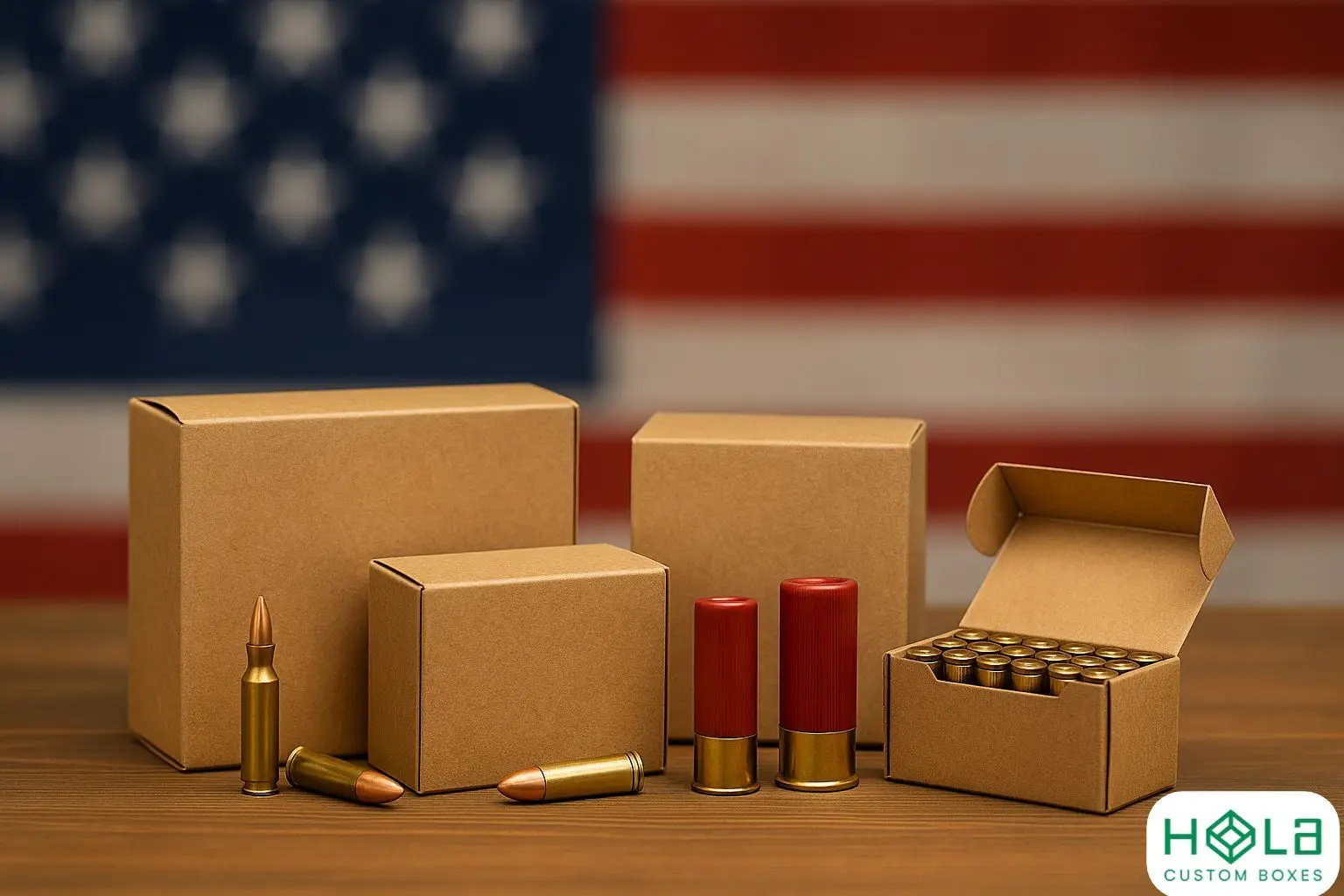
Choosing the right cardboard ammo box manufacturer isn’t about attractive pricing or generic claims—it’s about verified performance, compliance, and repeatable quality control.
When you source from Hola Custom Boxes, you’re not buying “standard cartons.” You’re buying packaging engineered to meet measurable strength targets, transit validation, and regulatory requirements.
If your ammunition packaging fails compression, vibration, or humidity exposure, the cost is far greater than the box itself—damaged rounds, rejected shipments, compliance risks, and lost trust.
Main B2B Decision Factors
Specify board grades tied to ECT/BCT or Mullen targets
Control flute direction, score depth, and dieline tolerances
Require ISTA-aligned drop, vibration, and compression validation
Confirm adhesive coat-weight control and closure retention force
Validate DOT / 49 CFR marking compliance and lot traceability
Lock in QC sampling, AQL criteria, and corrective-action workflows
If you are evaluating a Cardboard Ammo Box Manufacturer, these are non-negotiables.
Cardboard Ammo Box Manufacturer Selection Checklist
Before issuing an RFQ, map requirements to measurable capabilities.
1. Board & Structural Specs
Flute type: E, B, C, or BC double-wall
Caliper & basis weight
ECT or Mullen burst rating
Wet-strength additives (if humidity exposure expected)
Certified mill test reports (COA required)
2. Performance Validation
ISTA-aligned internal transit testing
Compression (BCT) validation
Drop & vibration profiles matching ship lanes
Cobb60 moisture absorption testing
3. Process Controls
Glue-line consistency
Score depth monitoring
Flute crush prevention
First-article dimensional reporting
4. Traceability & Sustainability
FSC / SFI substrate options
Recycled content tolerances
Lot labeling & date coding
With Hola Custom Boxes, specs are locked before production—so performance is engineered, not assumed.
What Cardboard Ammo Boxes Must Survive in Transit
.jpg)
Ammo boxes may look simple—but transit is not.
They must withstand:
Repeated edge drops
Sustained pallet compression
High-frequency vibration
Humidity fluctuations
Dynamic shear on closures
Poor design can cause:
Cartridge rattle
Primer strike risk
Bullet setback
Partition migration
Seam pop-open failures
At Hola Custom Boxes, internal clearances, partition geometry, and reinforcement structures are defined with tolerance bands—ensuring tray security and orientation retention.
Board Grades That Match Load Profiles
Board grade determines your structural baseline.
When to Use Higher ECT
Long-span stacking
Palletized warehouse storage
Heavy case loads
When to Use Higher Mullen Burst
Sharp-edge abrasion risk
High puncture exposure
Rough carrier handling
For most ammunition loads:
C-flute: balanced rigidity
B-flute: tighter stacking & cleaner scoring
BC double-wall: high top-load margin
Always require:
Mill certifications
Consistent flute orientation
Moisture tolerance documentation
Fit & Tolerance Engineering
Structural strength means little if fit is inconsistent.
Specify:
Internal tolerances (±0.5–1.5 mm per side)
Tray-to-wall clearance limits
Caliper moisture range
Squareness verification
Compression-set evaluation
Warpage changes tray engagement under vibration. Tight tolerances prevent rattle and migration.
Closure Integrity & Retention Testing
Closure geometry determines whether your box stays shut from warehouse to range.
Common options:
| Closure Type | Spec Driver | Verification |
|---|---|---|
| Reverse tuck | Caliper & score width | Opening force test |
| Roll-end tuck | Ply bond strength | Drop + vibration |
| Tear-strip + tuck | Adhesive retention | Peel & reclose cycles |
Retention force should be measured after:
23°C / 50% RH conditioning
Drop testing
Vibration cycling
Glue coat weight and dwell time are controlled variables at Hola Custom Boxes.
DOT & 49 CFR Label Compliance
Ammunition is regulated cargo.
Packaging must support:
Limited Quantity labeling
Country-of-origin marks
Shipper & consignee identification
Durable barcode placement
Legible lot/date codes
Label materials should include:
BOPP or PET facestock
Permanent acrylic adhesive
Moisture & abrasion resistance
Compliance marking must survive rub, peel, and drop exposure.
Print Quality & Barcode Validation
Even structurally sound packaging fails audits if barcodes do not scan.
Control factors include:
X-dimension consistency
Quiet-zone spacing
Dot gain & ink density
Registration across flaps
Rub resistance
Hola Custom Boxes validates barcode grade and lot-to-lot repeatability—not just visual approval.
RFQ Specifications You Should Send
A professional RFQ should include:
Board grade & caliper
Flute type
Basis weight
Moisture barrier requirements
Internal dimensions
Divider/insert specs
Load case (round count per box)
Required compression rating
Closure style
Glue pattern
Print process & ink type
Barcode quiet zone requirements
Dieline files (PDF + 3D)
Quantity breaks
Lead times
Packing & palletization details
The more precise your RFQ, the more reliable your production outcome.
Quality Control Testing Requirements
Each production lot should be verified through:
Basis weight & caliper testing
Moisture content measurement
Cobb60 water absorption
ECT / BCT compression tests
Mullen burst tests
Adhesive peel & shear pulls
Dimensional tolerance checks
Barcode grading
Vibration + drop simulation with loaded weight
Spec-driven QC reduces defect recurrence across production lots.
Why B2B Buyers Choose Hola Custom Boxes
When sourcing from Hola Custom Boxes, you gain:
Defined ECT/BCT targets
Flute & caliper control
Moisture-resistant liner options
Tight dieline tolerances
Custom die-cut inserts & partitions
Barcode & lot-code validation
Documented QC sampling
Corrective-action reporting
Warehousing & scheduled release options
You are not buying packaging.
You are buying measured performance consistency.
If you need a reliable Cardboard Ammo Box Manufacturer, your spec should define the partnership—not marketing language.
Explore more at:
https://holacustomboxes.com
https://holacustomboxes.com/product/cardboard-ammo-box-manufacturer
Frequently Asked Questions
What Is the MOQ for Custom Cardboard Ammo Boxes?
Digital runs may start at 100–500 units. Offset + die-cut production typically starts at 1,000–5,000 units. Inserts, rigid grades, and specialty finishes increase MOQ.
What Is the Typical Lead Time?
10–20 business days from artwork approval. Specialty finishes add 3–7 days.
Can I Get Unprinted Samples?
Yes. Blank structural samples can be provided in your specified board grade and caliper for fit validation.
Do You Offer Warehousing?
Yes. Scheduled release programs allow palletized inventory storage with lot tracking and PO call-offs.
What Payment Terms Are Available?
ACH, wire, credit card, or approved Net 30/45 terms after review. Shipping options include EXW, FOB, and DDP.
Final Thoughts for Procurement Teams
You cannot treat cardboard ammo boxes like commodity cartons.
You need:
Structural verification
Transit validation
Regulatory compliance
Dimensional precision
Repeatable QC
A professional B2B partnership means your packaging performance is documented, measurable, and consistent.
When you choose Hola Custom Boxes, you choose spec-built ammunition packaging engineered for reliability.